



Blog
Interiors 2025: Furniture as a Cultural Code


How Italian Design Defines the Culture of Contemporary Living
Form, Material, and Meaning: Why the Interior Is No Longer a Backdrop, but an Active Participant in Life
Design in 2025 is reshaping the way we think about the home. Furniture is no longer merely ‘function with form’, but a vehicle for ideas, taste, and philosophy of life. The interior ceases to be a backdrop — it takes an active part in everyday life, setting the atmosphere and declaring an identity.
Organic Design: The Science Behind Soft Lines
Rounded silhouettes are replacing rigid angles. This is not a passing whim, but a direction underpinned by the psychology of space: fluid lines evoke a calmer response and instil a sense of security. Organic forms, however, demand restraint. In confined spaces, their excessive use can create visual clutter. The most effective approach is to feature one or two pieces with a distinctly organic form per room — as a focal point, rather than a backdrop. Enhance this softness with concealed LED lighting or diffused light; this allows the contours to ‘breathe’ while keeping volumes distinct.
Curved furniture pairs best with timber, stone, or textured textiles. This synergy enhances the sense of authenticity, rendering the interior simultaneously modern and timeless. Balance is essential: bold forms require a tranquil palette.


The Tactile Revolution: Sensoriality and Responsibility Towards the Future
In a world where an ever-greater portion of life is lived digitally, interior design for 2025 turns its focus back to a primal sensation — touch. Textures take centre stage, transforming the home into a space to be truly experienced. Materials such as bouclé, wool, linen, and timber bring warmth and comfort, whilst microcement and mineral composites add solidity and depth. The interior is no longer a static background, but a living environment that engages the senses.
Indeed, this tactile revolution is intimately connected to an even broader movement — environmental sustainability. In 2025, it is no longer viewed as a compromise, but as integral to the very definition of luxury interiors. Italian manufacturers increasingly utilise recyclable materials and innovative technologies that minimise waste and conserve resources without sacrificing elegance. In this way, design attains a new, holistic value: it is at once aesthetically refined, sensorially compelling, and mindful of the future.
Sculptural Design: Furniture as an Art Investment
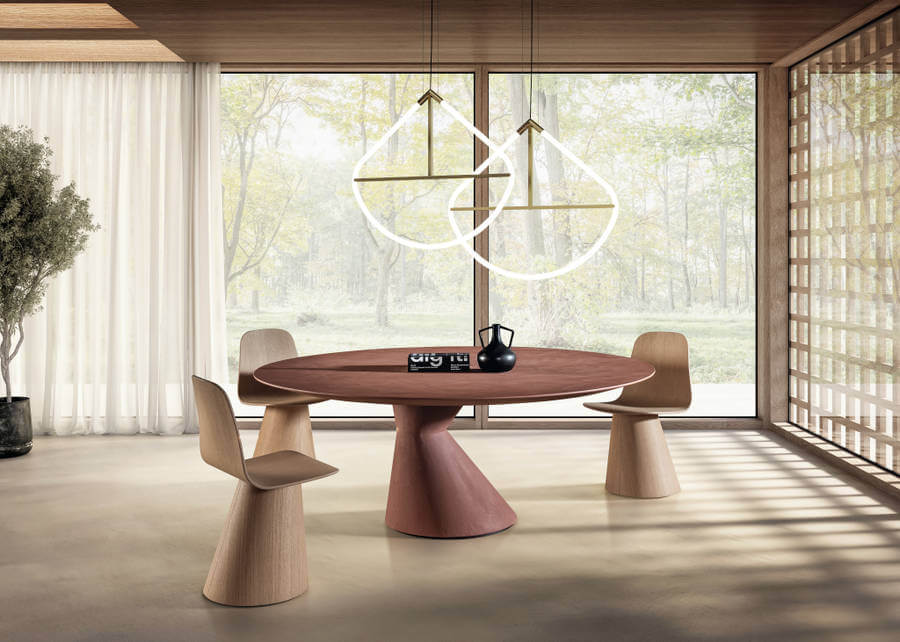
The boundary between furniture and artwork is becoming increasingly subtle. Dining tables with architectural bases, sculptural lamps, and armchairs with daring silhouettes are no longer merely functional items, but pieces possessing collector’s value. However, this artistic focus can sometimes place aesthetics before comfort — tables with unconventional shapes may prove impractical, whilst sculptural armchairs can be less comfortable for extended use.
This is precisely why statement furniture is at its most striking in reception areas such as the entrance hall, dining room, or study, where it can serve as a compelling focal point. In everyday living spaces, it is wiser to rely on proven ergonomic solutions, whilst a single bold sculptural accent is more than sufficient to impart a unique character to the interior without overwhelming it.

Colour Psychology: Earthy Tones with Deep Accents
The interior palette of 2025 turns decisively towards earthy tones — terracotta, olive green, and copper brown. They evoke a sense of tranquillity and stability, whilst deep accents in burgundy, graphite, and navy introduce an elegant drama and visual depth. To achieve the desired balance, however, it is important to bear in mind that saturated colours can visually diminish smaller spaces. Consequently, they are most effective as accents in soft furnishings, feature walls, or furniture of lighter proportions, combined with neutral tones and pale surfaces. In this manner, earthy shades infuse warmth and sophistication without feeling visually overbearing.
Interior design in 2025 establishes a new paradigm: furniture is an expression of identity. It marries form and sensation, tradition and innovation, functionality and emotion. A discerning choice does not compromise between aesthetics and practicality — it unites them into a harmonious whole. Italian design proves once again that high-calibre furnishings are not an expense, but an investment in a way of life. In an era of rapid change, the home remains the one sanctuary that truly belongs to us — and it deserves our very best.